
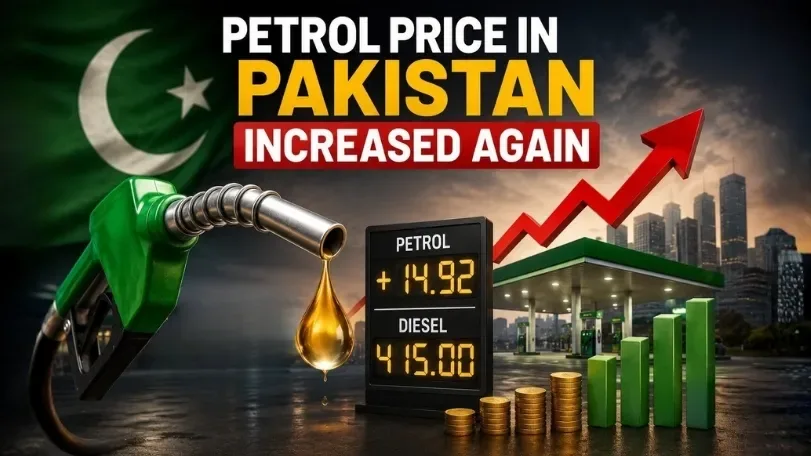
The Government of Pakistan has once again increased petroleum prices, creating additional pressure on households, businesses, and daily commuters already struggling with rising living costs.
According to the latest update, petrol price has increased by Rs14.92 per litre, while high-speed diesel has reached around Rs415 per litre. This sudden change has quickly become a major discussion point across Pakistan because fuel prices directly influence transportation, food prices, construction costs, and overall inflation.
This update is not just about fuel - it affects almost every part of daily life.
Why Petrol Prices Keep Increasing in Pakistan
Petrol prices in Pakistan are not fixed locally. They depend on international oil markets, currency exchange rate, taxes, and government policy.
When global crude oil prices rise or the Pakistani rupee weakens against the dollar, fuel prices automatically increase in the local market.
Pakistan is an import-dependent country for energy, which means any global instability directly impacts local petrol and diesel rates.
In recent months, rising import costs and economic pressure have made fuel price adjustments more frequent than before.
How Fuel Price Increase Affects Daily Life
Fuel price changes do not only impact car owners.
Almost every sector becomes expensive when petrol and diesel increase.
Transportation costs rise first, and then the effect spreads to food, delivery services, construction, and general goods.
Impact on Common People:
- Daily transport fares increase
- Grocery and food prices go up
- Delivery services become expensive
- Monthly household budget becomes tighter
Middle-class families feel the pressure the most because their income does not increase at the same speed as inflation.
According to economic studies, fuel price hikes directly contribute to inflation through transport and supply chain costs.
Impact on Economy and Inflation
Fuel is one of the most important cost drivers in Pakistan’s economy.
Even a small increase in fuel prices can raise overall inflation within weeks.
Recent reports show that fuel shocks can push inflation higher due to rising transport and energy costs across the country.
When petrol or diesel increases, it affects:
- Trucking and logistics costs
- Agricultural production
- Manufacturing expenses
- Market supply chains
This is why petrol price updates are closely watched by businesses, investors, and policy makers.
Impact on Construction and Real Estate Sector
The construction and property sector also feels the effect of fuel price changes.
Diesel is widely used in transporting construction materials like cement, steel, bricks, and sand. When fuel becomes expensive, transportation costs increase, which raises overall project costs.
This can indirectly affect:
- Housing development costs
- Property pricing trends
- Construction timelines
- Urban development projects
For investors and buyers, rising fuel costs are an important economic signal because they influence long-term development expenses in cities like Islamabad, Lahore, and Karachi.
If you are exploring property investment opportunities, you can also check developments and residential options at Gulberg green Islamabad.
Public Reaction and Economic Pressure
The recent fuel price increase has created strong public reaction across Pakistan.
Many households are already dealing with inflation, so fuel price hikes make monthly budgeting more difficult.
Transporters and delivery services are expected to adjust fares, which will further increase prices of essential goods in local markets.
Experts believe fuel prices will continue to play a major role in shaping inflation trends in the coming months.
What Can Happen Next?
If global oil prices remain unstable, local fuel prices may continue to rise.
However, if markets stabilize and the rupee strengthens, some relief may be possible.
For now, both businesses and households need to adjust to changing fuel costs.
Future petrol prices will depend on several key factors:
- International crude oil prices
- Exchange rate stability
- Government tax policy
- Global economic conditions
Final Thoughts
The latest petrol and diesel price increase is another reminder of how global economic conditions directly impact Pakistan’s daily life.
Fuel prices affect transport, food supply, construction, and inflation making them one of the most important economic indicators in the country.
As inflation continues to rise, careful financial planning is becoming more important for both individuals and businesses.
For investors and property buyers, fuel price trends also matter because they influence development costs and long-term market behavior.